facebook twitter
    Home

Habele Blog


Four students who attend Yap Catholic High School with support from Habele K-12 tuition scholarships earned "Second Honors" certificates for their work in the third quarter.

"We're proud of their hard work and commitment to success in the classroom," explained Alex Sidles.

Sidles, a Habele board member and former classroom teacher in Micronesia, was in Yap to visit the Yap Catholic students and their families. He also toured the SDA School and Saint Mary's, the two other independent schools in Yap where Habele students are enrolled.

"It is clear these students are driven and their parents are really engaged in their education. The high expectations at home and in the classroom foster a real culture of success," continued Sidles.

Several of the Habele students at Yap Catholic are also participating in the Habele-sponsored Robotics Club. That group plans to have public exhibition for members of the community sometime later this semester.

Photos of the school, students and robotics clubs are posted on Habele's Facebook page.

Share
April 09, 2012 No comments


A few boys with their master canoe carver, Joseph Yetigmal of Lamotrek, cut down a tree and planted ten in replacement on Friday, March 30, 2012 to commemorate the FSM Culture Day.

The boys did not waste any time after the tree had fallen and began carving out the hull of a sailing canoe. Project Coordinator Larry Raigetal of Waa’gey said the log will be moved to the canoe house at the Yap Living History Museum for completion. It will take couple days to work in the jungle to reduce unnecessary weight of the log before transporting it to the museum site.

The project, which aims to be completed by next month (april) will have the boys continue learning canoe carving and other traditional skills. It will also allow for students around the island to observe and participate thru organized school visits.

Once complete, the canoe will be used to train teams for the upcoming canoe festival now slated to take place the early weeks of November 2012. Mr. Alex Sidles, a board member of Habele, a US based nonprofit organization, and partner with Waa’gey, was on site to join the project launching.


Waa’gey has been working with the boys group from Lamotrek in promoting cultural and traditional skills learning. The group, through an arrangement by the Yap Traditional Society and the Yap Living History Museum, has been providing canoe tours and traditional skills demonstrations on Tuesdays and Thursdays at the canoe houses.


This canoe project is in partnership with the coalition of Yap Against Drugs and Alcohol (YADA),  Habele, Yap Traditional Navigation Society, and  the Yap Living History Museum.


Share
April 02, 2012 No comments


Colonia, Yap - A group of young men in Micronesia are putting the final careful touches on a traditional dugout canoe they built.

The teenagers, who have been working in Gargey on Yap, are Lamotrekese. They’re the sons of families who’ve migrated to Yap Proper from the much smaller islands and atolls further to the east known as the “Outer” or “Neighboring Islands.”

“As far as we know, this is the first time Outer Islanders have ever built a canoe on Yap for our own use,” proudly observes Larry Raigetal, one of the men who helped establish the project. “That makes this really special.” Raigetal is also from Lamotrek, a tiny coral atoll of 400 people about 600 miles from Yap.

Historically, Outer Islanders traded finished goods such as woven skirts and mats for canoes built on Yap Proper. This was part of a far-reaching pattern of trade and tribute that spanned hundreds of miles across the Caroline Islands in the Central Pacific Ocean. Raigetal explains how the promise of healthcare, education and employment has drawn more and more Neighboring Islanders to the larger, more developed islands in Micronesia that serve as that nation’s four state capitals. “One of the complications of the move is the break that many people -especially the young people- have with their families’ traditions. Those traditions are based on the routines of social life in the isolated Outer Islands.”

The project, which goes by the name of “Waagey” (an Outer Island term for “future”) has been a partnership between young and old; between those who’ve come to call Yap Proper home and those who remain in the Neighboring Islands. One of the more experienced canoed builders from Lamotrek named Xavier Yarofaliyango travelled aboard a state owned cargo vessel to Yap. Yarofaliyango and the traditional navigator Ali Haleyalur served as mentors and guides for the young men.

“This is a journey, which is how we think about canoes and travel in our islands, but this is also a return” says Ali Haleyalur. Waagey complete its first small canoe (roughly 15 feet long) in early March.
The group has also fallen and dugout logs for a second, much larger canoe, which may be in the 30 to 35 foot range. The makings of that larger canoe, which could ultimately be among the longest traditional Caroline Island canoes in existence, will be sent to Lamotrek aboard the state vessel soon. It will be completed in the Outer Islands, giving more young men a connection to the project.


“This is a great locally grown effort,” explained Scott Leis, a volunteer with the US-based Habele Outer Island Education Fund. Habele is a group of former Peace Corps volunteers and other Americans working to support K-12 aged students Micronesia. They provided Waagey with chainsaws and money for paint and other supplies. “Not only does this revive an important traditional activity and sense of cultural identity,” said Leis, “it also gives young men a sense of belonging and accomplishment. That seeps through all aspects of their lives.” Leis, who was in Yap to help with the project last month, explained that Habele also supports low-income Outer Island students at the small private schools on Yap through tuition scholarships.

Raigetal sees these two canoes as a solid first step. His wife, Regina, is working in parallel with young Outer Island women on Yap. They’ve begun to pair older women with young girls and teens, passing on the intricacies of traditional weaving techniques used to create Lava Lavas (distinctive skirts with horizontal lines) and handicrafts. Regina, a native of Fais Island, is also patterning with the Yap State Women’s organization and women’s groups in the Outer Islands. They are hoping to someday market some of the finished goods. “These items, with such a history and so much importance to our culture, can also be such a tool for the younger generation, to learn who they are and what they can accomplish.”


Share
March 12, 2012 No comments

The February issue of Robot Magazine details the progress of robotics clubs at Yap Catholic High School and the SDA School in Yap, Micronesia.

The article explains how Yap State’s two private high schools have announced an innovative new pro- gram to serve students with an interest in math and computers. The schools, Yap SDA and Yap Catholic, are each establishing robotics teams for their pupils. These student teams, with support from teachers and other school staffers, will design, build and operate basic robots. Both teams have been equipped with classroom robotics kits from VEX Robotics.

The Habele Outer Island Education Fund donated the kits along with teacher guides and the equipment required for using desktop computers to program the robots.

A prominent VEX Robotics team based at the Chaminade College Preparatory high school in West Hills, California, Eagle Engineering Team #1138, is at the root of this story.


In 2008, Eagle Engineering began sending textbooks from all academic disciplines to Micronesia to help build up resources for two new high schools. Eagle Engineering sent the texts to Father Corcoran, director and principal Yap Catholic high school on the island of Yap. Corcoran used the texts to build libraries for the school and shared the donations with other public and private schools in Yap State.. The book program was launched by former Chaminade student Amelia Weiss, a team alumni who is now at the University of California, Berkeley majoring in marine biology and engineering.

In the last year, Eagle Engineering began creating instructional videos for the Micronesian students, as well. These videos cover robotics basics, programming and more. In recent months, the team sent two VEX Robotics Starter Kits to the students, as well as a VEX game playing field and game elements. From the beginning, the Habele Outer Island Education Fund, a philanthropic foundation, provided funding for Eagle Engineering to make this outreach possible.


Share
February 28, 2012 No comments

Canoes are being carved in Gargey, Yap.

The program is a joint effort of "Waagey," a Yap based community organization, and Habele, a U.S. based charity serving students across Micronesia since 2006.

One of the more experience canoe builders from Lamotrek named Xavier and the navigator, Ali, have come to support young men from Lamotrek and other Outer Islands who now live on Yap Proper complete the project.


The project leaders feel that young people from Lamotrek who have been living in Yap their whole lives are Outer Islanders in name only. Those young men and women struggle with the basic skills traditional required for village and family life. The groups's vision is to use instruction in traditional skills to build a sense of identiy and accomplishment among these youth.

More great photos here.

Share
February 21, 2012 No comments


Habele directors and volunteers have been working to support young men from the Atoll of Lamotrek living on Yap Proper. Yap is the state capital of one of four states in the Federated States of Micronesia (FSM). A club was organized in November of 2011, with weekly meetings in Gargey. The group has set itself very ambitious goals.

Working with elders from the Outer Island community on Yap, club members have put coconuts husks to sea, which will be ready for local twine rope making by early 2012. They also started carving a mid size traditional dugout canoe, building towards the goal of initiating the creation a second, much larger canoe by mid 2012. Habele donors will help bear the costs of sending traditional building materials and tools from Lamotrek to Yap and back on the state owned cargo ship to facilitate the process.


The islanders participating understand that Neighboring Island migration to the center (Yap Proper and the other four state capitals) continues to grow at a staggering rate. Most often, children and grandchildren of these migrants do not experience the typical Outer Island men's house experiences. The result is both a concrete loss of specific and specialized skills passed down through such meetings, and the distinctive Outer Island cultural identity that flow from them.


Share
February 10, 2012 No comments

Report cards are arriving, detailing the academic progress of Habele's scholarship winners through their first semester of the 2011-12 school year.

Each of the 24 students is attending a prestigious private school with the support of a K-12 tuition scholarship that covers roughly 75 percent of enrollment costs. The students come from atolls and islands throughout the Federated States of Micronesia (FSM). The schools they attend are situated on the "larger" or "high" islands that serve as State Capitals.

Nationwide, only half of K-12 students graduate high school. Among those entering the Micronesian college system, only one-in-ten graduate with a degree. Students from private secondary schools have much higher graduation and completion rates in Micronesia, and are consistently reported to be "better prepared" to succeed at the post secondary level.

Habele was created by a group of former Peace Corps Volunteers who taught in classrooms across Yap and Chuuk States. Initially focused on Outer Island students, the organization identifies needy students seeking to attend private K-12 schools and provides their family with financial support in the form of tuition scholarships. Checks are issued directly to reputable independent schools. Habele works with these families, and the schools their children attend, to keep detailed records of the students’ personal and academic progress throughout the school year.

Habele also supports students and schools of all types through targeted donations of books, classroom supplies, as well as the creation of local language materials. Habele is a US-based not-for-profit organization, recognized by the Internal Revenue Service (IRS) with no full-time salaried employees.

Habele has been raising money from individual and corporate donors across the United States to fund tuition scholarships since 2006. Donors and volunteers support Habele because of an interest in education in Micronesia and the knowledge that Habele responsibly serves educational needs in an efficient and effective way.


Share
January 24, 2012 No comments

Yap State’s two private high schools have announced an innovative new program to serve students with an interest in math and computers.

The schools, Yap SDA and Yap Catholic, are each establishing robotics teams for their pupils. These student teams, with support from teachers and other school staffers, will design, build and operate basic robots. The long-term goal is for each school to create a robot capable of completing a basic obstacle course at a public demonstration.

Both teams have been equipped with classroom robotics kits from Vex Robotics, an American firm that creates the components for elementary and high school level robots. The Habele Outer Island Education Fund donated the kits along with teacher guides and the equipment required for using desktop computer to program the robots.

Another charity, the Yap-based “Wagey” is providing the schools with on-the-ground support as they assemble the kits and organize their teams. Wagey will work as a link between the two schools on Yap and a robotics team at a high school in the United States who’ve offered to provide technical advice and problem solving.

“This project robot is really interesting," said Kalahao Fillmed, a student at the SDA School who plans to participate in the project. “It’s gonna be fun!”

Habele purchased the kits in late October and they reached Yap in mid-November.

The donation marks a significant expansion for Habele. The group is better known in Micronesia for its annual K-12 tuition scholarships, a program to help low-income families send their children to non-public schools. Habele has been providing those scholarships and donating materials to public schools and libraries since 2006.

Share
December 02, 2011 No comments

This is an editorial guest column published in the Honolulu Star Advertiser (link) on November 23, 2011 under the title "Teach a man to fish." It is a response to this editorial calling for a revision to the immigration provisions of the Compacts of Free Association.

One billion dollars over the last six years.

That’s the estimated cost for government services provided to migrants from the Federated States of Micronesia (FSM), the Marshall Islands and Palau living on Hawaii and Guam. It’s separate and addition to direct U.S. assistance to those three island nations.

Frustration with the costs is growing. The money could be going to fund other core government services in Hawaii and Guam, or fuel growth in the private sector economy that created it. Spending on services and entitlements for these immigrants is really just a symptom: one manifestation of the faltering relationship between the United States and its long-time strategic partners in the Pacific.

Pacific Islanders from the three nations may enter and reside indefinitely in the United States, bypassing visa and labor certifications required of other immigrants. That’s a benefit provided by the Compacts of Free Association, those bi-lateral treaties that solidify America’s unique relationship with these three Freely Associated States (FAS).

Inevitably, the vast majority of FAS immigrants make their way to Hawaii and Guam. Their children attend public schools. Most of these students require remedial instruction in English and other subjects. Many claim free or reduced cost school meals. FAS citizens are eligible for Medicare and Emergency Medicaid programs. Among older FAS immigrants, high rates of obesity, diabetes and hypertension lead to heavy medical costs. There’s also federal or state rent support for FAS families. It all adds up.

Geography explains why the impact of the Compact is disproportionately borne by Hawaii and Guam. It cannot account for the sheer size of that impact. That is a story of costly disappointments and unintended consequences.

Consider the FSM. Half of Micronesians over 25 are now high school dropouts. Only one-in-ten who enter the two-year community college system graduate from it. Private sector unemployment is rampant and a third of the national population lives below the “Basic Needs” poverty level. The IMF ranks Micronesia in the bottom quarter of its worldwide “ease of doing business” survey. All that is despite $130 million in annual assistance programs from the U.S. Government.

The bleak conditions at home explain why an estimated 56,000 Micronesians, Marshallese and Palauans now reside in the United States. They comprise nearly a quarter of those nations’ total populations. Over half of these immigrants come to Hawaii and Guam.

The original intent of American support to the three Freely Associated States was to build the capacity for economic and political self-sufficiency in those nations. Despite decades of assistance, the FAS remain poor and dysfunctional, so many of these Micronesians, Marshallese and Palauans understandably seek greener pastures in the U.S.

A skeptic might argue that, thanks to their remote location and lack of natural recourses, small isolated island nations are “automatically” destined for permanent financial dependency; that political and financial sovereignty are unobtainable. But none would claim the present situation is the best that can be realized. The problem is not the size or scope of U.S. support, the problems lay within the ways that money is structured, allocated and managed. Private investment is crowded out, local decision-making and initiative hampered, and civil society woefully underdeveloped.

No one has better means or motivation to advocate for improved development in the Freely Associated States than the people of Hawaii and Guam. Hawaiians and Guamanians have a unique appreciation of the strategic importance of American forces and transit in the Central Pacific. Likewise, they have a heightened sensitivity to the influx of immigrants who are themselves frustrated with the state of under-development in their home islands.

If the people of Hawaii and Guam can direct mainland Americans’ attention to solving economic and political challenges in the Freely Associated States, then they will accomplish much more than just reducing the short term “Compact Impact” costs they now struggle with.

About the author: Neil Mellen is President of the Habele Outer Island Education Fund, a South Carolina based charity that supports Micronesian students through private school scholarships, library donations and academic competitions.

Share
November 23, 2011 No comments


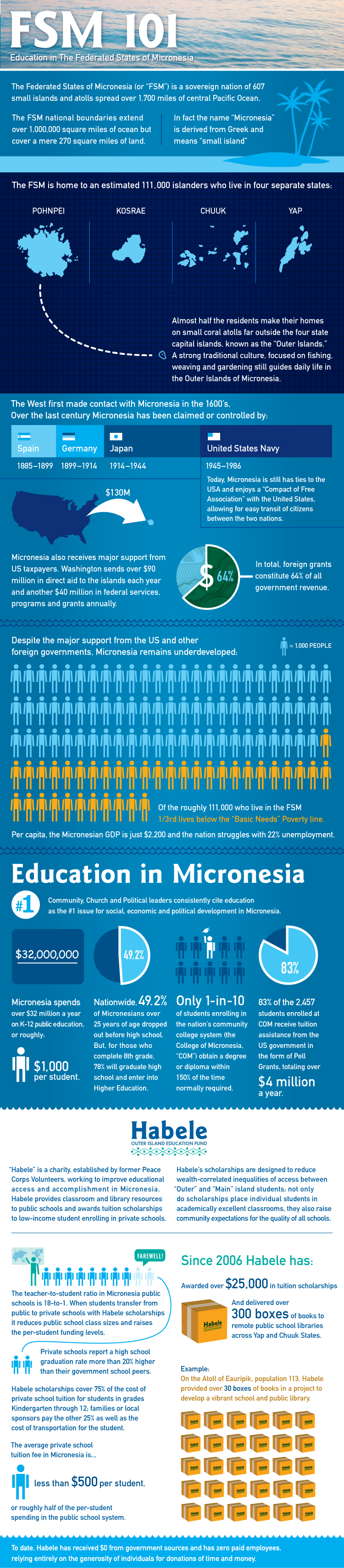
What is Micronesia? Where is Micronesia? And how can I help students there?

Learn all this and more by viewing the latest edition of the Habele Micronesia infographic: "FSM 101."


Share
October 14, 2011 No comments
Newer Posts
Older Posts

Search This Blog

Popular

  • Mary Dorothy Alexander Vickers
    Mary Dorothy Alexander Vickers
    Mary Dorothy Alexander Vickers Dorothy “Dot” Vickers, 91, of Winchester, Virginia, passed on to the Lord, August 27, 2013, at Consultant Nur...
  • Scholarships Help Low Income Students Across Micronesia
    Scholarships Help Low Income Students Across Micronesia
    Photo: Students working at Yap Catholic High School. YCHS is one of eight schools across Yap, Chuuk and Pohnpei where Habele supports studen...
  • Books Headed to Pohnpei, Micronesia
    Books Headed to Pohnpei, Micronesia
    US-based charity “ Habele ” has begun shipping books to the Micronesian island of Pohnpei as part of a statewide public literacy project. Th...
  • 2007-08 High School Scholarships Awarded
    2007-08 High School Scholarships Awarded
    (July 31, 2007, Columbia, South Carolina) The Habele Outer Island Education Fund announced today that it is awarding over $3,500 in high sch...
  • Habele 2009-10  Scholarships Forthcoming...
    Habele 2009-10 Scholarships Forthcoming...
    The Habele Outer Island is preparing to announce the winners of it's 2009-10 school year tuition scholarships . We hope to provide tuit...

Labels

Adze Amata Coleman Radewagen Arts and Crafts Aumua Amata Barbara Wavell books Canoe Canoe carving Caroline Islands Chaminade China Chuuk Climate Change COFA Compact Impact Compact of Free Association Culture David Hamon Department of the Interior donation donations Doug Domenech Eagle Engineering eauripik Elato Euripik Extracurricular fais Faith Christian Academy Fans Faraulep FAS federai federated states of micronesia Festival of Pacific Arts 2016 FGC2017 FIRST Global Freely Associated States fsm Guam Habele Habele Outer Island Education Fund Habele Robo League Humanitarian Ifalik Intern Internship Joe Wilson Kolonia Lamotrek Language Larry Raigetal LEAD Libraries literacy Madolenihmw Marshall Islands Marshalls Matson Maysak Micronesia Micronesian Moving Past Maysak navigation News Office of Insular Affairs OIA Outer Islands Outer Islands High School outrigger canoe Pacific Arts Palau Peace Corps Piik pohnpei Power Hawks Proa Public Schools reading Relief Relief Effort Reports Republic of Palau Republic of the Marshall Islands robotics Robots sail sailing Satawal Satowan Scholarships school supplies Second Island Chain Sports Sports Council Star-Advertiser STEM Summer temwen Tomil traditional canoe traditional navigation traditional sailing Typhoon Ulithi VEX Robotics Waa'gey waagey weaving Woleai Woven Fans Yap Yap Catholic High School Yap Games Yap High School Yap Outer Islands Yap Robo League Yap SDA Yap SDA School yap state

Blog Archive

  • ▼  2018 (5)
    • ▼  June (1)
      • Interior Announces Funds to Extend Yap Robotics Le...
    • ►  May (2)
    • ►  March (2)
  • ►  2017 (14)
    • ►  December (1)
    • ►  November (3)
    • ►  September (1)
    • ►  August (1)
    • ►  July (1)
    • ►  May (2)
    • ►  April (2)
    • ►  March (2)
    • ►  January (1)
  • ►  2016 (23)
    • ►  November (3)
    • ►  October (2)
    • ►  August (4)
    • ►  July (2)
    • ►  June (6)
    • ►  May (2)
    • ►  April (3)
    • ►  February (1)
  • ►  2015 (23)
    • ►  December (1)
    • ►  November (2)
    • ►  August (1)
    • ►  July (2)
    • ►  June (1)
    • ►  May (3)
    • ►  April (11)
    • ►  February (2)
  • ►  2014 (7)
    • ►  November (2)
    • ►  October (1)
    • ►  August (1)
    • ►  June (2)
    • ►  January (1)
  • ►  2013 (30)
    • ►  December (1)
    • ►  October (2)
    • ►  September (4)
    • ►  August (1)
    • ►  July (5)
    • ►  May (6)
    • ►  April (2)
    • ►  March (2)
    • ►  February (4)
    • ►  January (3)
  • ►  2012 (30)
    • ►  December (5)
    • ►  November (4)
    • ►  September (1)
    • ►  August (2)
    • ►  July (1)
    • ►  June (3)
    • ►  May (4)
    • ►  April (5)
    • ►  March (1)
    • ►  February (3)
    • ►  January (1)
  • ►  2011 (12)
    • ►  December (1)
    • ►  November (1)
    • ►  October (1)
    • ►  September (2)
    • ►  August (1)
    • ►  July (2)
    • ►  June (1)
    • ►  March (1)
    • ►  February (1)
    • ►  January (1)
  • ►  2010 (16)
    • ►  December (1)
    • ►  October (1)
    • ►  September (1)
    • ►  August (1)
    • ►  July (1)
    • ►  June (3)
    • ►  May (2)
    • ►  April (1)
    • ►  March (1)
    • ►  February (1)
    • ►  January (3)
  • ►  2009 (29)
    • ►  December (3)
    • ►  November (5)
    • ►  October (4)
    • ►  September (3)
    • ►  August (5)
    • ►  July (1)
    • ►  May (1)
    • ►  April (2)
    • ►  March (1)
    • ►  February (2)
    • ►  January (2)
  • ►  2008 (22)
    • ►  November (1)
    • ►  October (1)
    • ►  September (2)
    • ►  July (1)
    • ►  June (2)
    • ►  May (3)
    • ►  April (1)
    • ►  March (4)
    • ►  February (3)
    • ►  January (4)
  • ►  2007 (47)
    • ►  December (3)
    • ►  November (1)
    • ►  October (4)
    • ►  September (4)
    • ►  August (2)
    • ►  July (2)
    • ►  June (6)
    • ►  May (4)
    • ►  April (4)
    • ►  March (8)
    • ►  February (4)
    • ►  January (5)
  • ►  2006 (42)
    • ►  December (5)
    • ►  November (6)
    • ►  October (5)
    • ►  September (4)
    • ►  August (3)
    • ►  July (6)
    • ►  June (6)
    • ►  May (7)
Powered by Blogger.

Categories

Created with by ThemeXpose