facebook twitter
    Home

Habele Blog


UOG President Dr. Underwood stands with the traditional navigators from the Lamotrek, Yap State, Micronesia at a ceremony celebrating their voyage (link).

For centuries, the people of the central Caroline Islands have relied heavily on their voyaging canoes as their primary means of transport. They made voyages to islands near and afar to obtain necessities including food, tools, and other valuables. In some instances, following devastating natural calamities, their canoes are used to relocate to a different island as was the case for the “Carolinians” now residing in the Commonwealth of the Northern Marianas (CNMI). 

Today, the art of canoe building and traditional celestial navigations, continues in these remote islands of the Federated States of Micronesia. Although at a smaller scale than what it used to be, the important knowledge of their ancestors is being passed on to younger generations. Waa’gey is a community-based organization that is working with their island communities to promote traditional skills and knowledge transfer.

Realizing the challenges brought to the shores of Micronesia by globalization and environmental issues—including climate change and rising sea levels—the people of Lamotrek Atoll in Yap State worked with Waa’gey’s Larry Reigetal and his crew to refurbish an outrigger canoe named The Lucky Star. Using only traditional seafaring methods and no modern navigation technology, the eight-man crew (Paul Haleyalpiy, Johnny Ratigulur, Noel Ukun, Iseah Yarofyan, Jackson Mailuw, Delson Twerital, Wilson Filmwai, and documentary film producer Douglas Varchol) led by Larry Reigetal braved storms and powerful ocean currents to travel over 500 miles to Guam over five days to participate and showcase their Micronesian culture in the Festival of Pacific Arts held in May 2016. After the festival, the crew sailed over 500 miles back to Lamotrek over a period of 10 days.

The crew brought along a traditional pandanus sail woven by the people of Lamotrek to use during Guam FestPac 2016, and to display the skills used to create it. The entire process of weaving the sail took more than six months, with over 30 people contributing to its construction.


Lucky Star's arrival on Guam

Due to modern seafaring technologies, the traditional weaving techniques in Lamotrek had not been in practice for over half a century.  However, through this project, Waa’gey was able to enlist the help of 95-year old Maria Labusheilam, the last master weaver in Lamotrek. She taught the skills to 20 women apprentices, led by her daughter Maria Ilourutog. The men of Lamotrek, led by Xavier Yarofaliyango, cut the pandanus leaves, and stretched and stitched the sail together. Labusheilam died two weeks after passing on the knowledge; she did not see the final outcome of her work. The sail is woven from the pandanus (or screw-pine) tree commonly grown on beaches of almost all tropical islands. 

The leaves are harvested, dried under the sun, and stripped into single fibers. They are then woven into longer strips of sheets, which are then strengthened by stretching and wrapping the sheets around coconut palm trees. The sheets are then sewn together with sennit twine ropes made from coconut fibers. The weaving of sails is not the same as weaving sleeping mats, as they need to be doubled and overlapped to ensure strength and durability.

Early post World War II canoe sail, outer islands of Yap, Micronesia.

The sail was previously displayed at the University of Guam and the Honolulu Museum of Art, and will be the main art display at the UN Headquarters during The Ocean Conference from June 5 – 9. 2017. It will then travel to Europe, Asia, and Australia before it makes its final voyage to the Federated States of Micronesia capital—Palikir—in time to sail the 2018 Micronesian Games torch to Yap next summer. It has been autographed by all the people from Lamotrek and the President of the FSM, His Excellency Peter Christian.


German anthropological drawing of Carolinian Sailing Canoes, circa 1890

In the center of the sail is the phrase “Falemwaiul Lamoireg?”, which means “Survival of Lamoireg’s Glory”. It highlights the community’s own struggle to combat the negative impacts of modernization—including environmental issues such as climate change and rising of sea levels. It is the hope of the Lamotrek people that this sail travels around the world to show their cultural heritage of the past—canoe building and voyaging—are not only applicable to our societies, but are indeed conducive to the environment in which we live.

Habele, a US-based nonprofit, is a proud partner of Waa'gey, providing targeted grants and equipping master and apprentice carvers with world class, culturally appropriate, tools.

Share
March 23, 2017 No comments

(HagÃ¥tña Harbor, Guam) This week, three hand-carved sailing canoes landed on Guam, completing a five-day voyage across the open ocean from Yap State. This arduous five day trek highlights the ongoing success of Waa’gey, a Yap-based mentorship program that trains island youth in traditional canoe carving and navigation. The voyage between Yap State and Guam served to bridge both time and cultures.

“Waa’gey students are trained to see the value in the traditions of our ancestors,” said Larry Raigetal of Lamotrek Atoll, the group’s Program Director. “They learned to build a large sailing canoe with their own two hands, and put traditional navigation into practice on a real voyage. The old ways still work.”

The canoes used were “Carolina Proas,” complex all wood outriggers designed, perfected, and made famous by Micronesians over centuries. Larry oversaw the project, captaining one of the sleek vessels that early Spanish missionaries called, “flying proas.” Designing, building and navigating traditional canoes requires tremendous expertise.

The Lucky Star, one of the three canoes from Lamotrek, used a completely hand woven pandanus sail. This is the only fully traditional sail employed by any canoe on the voyage, or even attending the  Festival of Pacific Arts, the Pacific-wide event which drew the sailors to Guam.

Historically, Outer Islanders traded woven skirts and mats for canoes built on Yap Proper. This was part of a complex trade network spanning hundreds of miles across the Caroline Islands, Guam, and even the Marianas.

Today, the promise of healthcare, education and employment has drawn Outer Islanders to the larger, more developed islands in Micronesia. Many Micronesians have taken the further step of migrating to Guam or Hawaii, an option afforded them through the Compact of Free Association between the US and Micronesia.


For a decade now, Waa’gey has used mentored canoe building to help tackle contemporary social and environmental challenges across Yap State. This mission is driven by the belief that traditional values and skills have an ongoing role in teaching young people to confront modern challenges. The young men who arrived in HagÃ¥tña are a testament to Waa’gey’s success.

"For thousands of years, our people have been healthy and happy on tiny island atolls,” explained Raigetal. “Traditional practices taught us to use natural resources, and also protect them. Our cultures have withstood a lot of change over the centuries, but we’re dealing with more outside influences than ever. We’re also aware of the threat rising sea levels pose to low-lying islands. It’s not a theory. It’s real to us. This voyage to Guam is something the boys are quite proud of, but it’s just one symbol of the hard work and challenges they face in navigating Micronesia's -and their own- future.”

Share
May 20, 2016 No comments

Great news reaches Habele from Francis Yarofalyango, a junior at Yap Catholic High School (YCHS). Francis has earned honors for perfect attendance and a high average across all six of his first quarter courses!

Francis is a native of Lamotrek an isolated, low lying coral atoll in Micronesia. Through his Habele Scholarship, he is able to attend a prestigious independent school on Yap Proper, the more populous State Capital.

Like many Habele scholars, Francis also participates in Habele sponsored enrichment and extracurricular programs, such as sports leagues and robotics teams. He even had a hand in the crafting of the US-FSM Friendship Canoe, which just arrived in South Carolina.

Francis -or "Cisco" to his teachers and close friends- is emblematic of the ambitious, driven students Habele seeks to support.

"Cisco had a tremendous quarter," explained Mr. Wiencek, the Yap Catholic Algebra II and Trigonometry Instructor. "He worked very hard for his grade and was a great help to his classmates during collaborative assignments." Social Studies teacher Mr. Mailen adds "Francis' passion to learn about history is obvious and it has driven him to excel."

Share
November 13, 2015 No comments


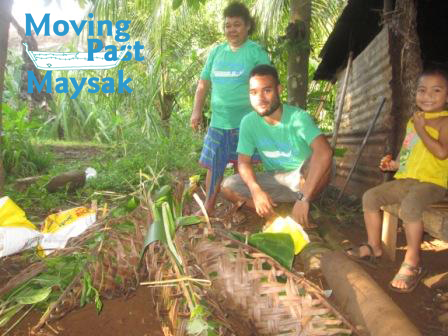
Micronesia's remote Outer Islands were fortunate enough to receive emergency supplies of food and water immediately after the destruction of Typhoon Maysak. These rations are crucial for short term survival, but the need to revive traditional, sustainable food sources is an ongoing need.

Volunteers with Waa'gey - a Habele partner organization - have jumped in to help bolster relief work with a long-term food solution for some of Yap State's most isolated Outer Islands.

Drawing on traditional and local knowledge of storm relief, Waa'gey volunteers collected over fifty baskets of traditional crop seedlings, which they will personally deliver to the atolls of Faraulep and Piik. Inside the baskets are over 500 plants, including taro, banana, tapioca, sweet potatoes and even mahogany trees. These are familiar crops, identified by islanders as the most targeted means of helping remote communities regain self-sufficiency.


Faraulep and Piik lie almost 500 miles east of Yap, and suffered 80% loss of food crops and infrastructure to Typhoon Maysak. The majority of this damage was directly from shoreline inundation. Islands and atolls even further east - Satawal, Lamotrek, Elato, Ifalik, Woleai, and Euripik - were fortunate to have avoided the worst of the storm, and sustained considerably less damage.


In addition to delivering plants to the island communities, Waa'gey volunteers will be lending their backs and chainsaws to clearing away the wreckage and debris. Many of these remote islands are confined to the use of the only limited hand tools, as chainsaws simply aren't available. Without the chainsaws and additional manpower, the task of clearing space to plant traditional food plots would be extremely daunting.


To donate directly to Habele's ongoing work in Moving Past Maysak:

or send check or money order to Habele, 701 Gervais St, STE 150-244, Columbia, SC 29201.
Habele is a tax exempt, all-volunteer, US based nonprofit with a proud history of high impact support for our partners in Micronesia.

Share


May 13, 2015 No comments
Older Posts

Search This Blog

Popular

  • Mary Dorothy Alexander Vickers
    Mary Dorothy Alexander Vickers
    Mary Dorothy Alexander Vickers Dorothy “Dot” Vickers, 91, of Winchester, Virginia, passed on to the Lord, August 27, 2013, at Consultant Nur...
  • Books Headed to Pohnpei, Micronesia
    Books Headed to Pohnpei, Micronesia
    US-based charity “ Habele ” has begun shipping books to the Micronesian island of Pohnpei as part of a statewide public literacy project. Th...
  • Scholarships Help Low Income Students Across Micronesia
    Scholarships Help Low Income Students Across Micronesia
    Photo: Students working at Yap Catholic High School. YCHS is one of eight schools across Yap, Chuuk and Pohnpei where Habele supports studen...
  • 2007-08 High School Scholarships Awarded
    2007-08 High School Scholarships Awarded
    (July 31, 2007, Columbia, South Carolina) The Habele Outer Island Education Fund announced today that it is awarding over $3,500 in high sch...
  • Micronesian Social and Economic Indicators
    Micronesian Social and Economic Indicators
    As part of our ongoing effort to keep Habele volunteers and donors informed about cultural and political developments in Micronesia’s remot...

Labels

Adze Amata Coleman Radewagen Arts and Crafts Aumua Amata Barbara Wavell books Canoe Canoe carving Caroline Islands Chaminade China Chuuk Climate Change COFA Compact Impact Compact of Free Association Culture David Hamon Department of the Interior donation donations Doug Domenech Eagle Engineering eauripik Elato Euripik Extracurricular fais Faith Christian Academy Fans Faraulep FAS federai federated states of micronesia Festival of Pacific Arts 2016 FGC2017 FIRST Global Freely Associated States fsm Guam Habele Habele Outer Island Education Fund Habele Robo League Humanitarian Ifalik Intern Internship Joe Wilson Kolonia Lamotrek Language Larry Raigetal LEAD Libraries literacy Madolenihmw Marshall Islands Marshalls Matson Maysak Micronesia Micronesian Moving Past Maysak navigation News Office of Insular Affairs OIA Outer Islands Outer Islands High School outrigger canoe Pacific Arts Palau Peace Corps Piik pohnpei Power Hawks Proa Public Schools reading Relief Relief Effort Reports Republic of Palau Republic of the Marshall Islands robotics Robots sail sailing Satawal Satowan Scholarships school supplies Second Island Chain Sports Sports Council Star-Advertiser STEM Summer temwen Tomil traditional canoe traditional navigation traditional sailing Typhoon Ulithi VEX Robotics Waa'gey waagey weaving Woleai Woven Fans Yap Yap Catholic High School Yap Games Yap High School Yap Outer Islands Yap Robo League Yap SDA Yap SDA School yap state

Blog Archive

  • ▼  2018 (5)
    • ▼  June (1)
      • Interior Announces Funds to Extend Yap Robotics Le...
    • ►  May (2)
    • ►  March (2)
  • ►  2017 (14)
    • ►  December (1)
    • ►  November (3)
    • ►  September (1)
    • ►  August (1)
    • ►  July (1)
    • ►  May (2)
    • ►  April (2)
    • ►  March (2)
    • ►  January (1)
  • ►  2016 (23)
    • ►  November (3)
    • ►  October (2)
    • ►  August (4)
    • ►  July (2)
    • ►  June (6)
    • ►  May (2)
    • ►  April (3)
    • ►  February (1)
  • ►  2015 (23)
    • ►  December (1)
    • ►  November (2)
    • ►  August (1)
    • ►  July (2)
    • ►  June (1)
    • ►  May (3)
    • ►  April (11)
    • ►  February (2)
  • ►  2014 (7)
    • ►  November (2)
    • ►  October (1)
    • ►  August (1)
    • ►  June (2)
    • ►  January (1)
  • ►  2013 (30)
    • ►  December (1)
    • ►  October (2)
    • ►  September (4)
    • ►  August (1)
    • ►  July (5)
    • ►  May (6)
    • ►  April (2)
    • ►  March (2)
    • ►  February (4)
    • ►  January (3)
  • ►  2012 (30)
    • ►  December (5)
    • ►  November (4)
    • ►  September (1)
    • ►  August (2)
    • ►  July (1)
    • ►  June (3)
    • ►  May (4)
    • ►  April (5)
    • ►  March (1)
    • ►  February (3)
    • ►  January (1)
  • ►  2011 (12)
    • ►  December (1)
    • ►  November (1)
    • ►  October (1)
    • ►  September (2)
    • ►  August (1)
    • ►  July (2)
    • ►  June (1)
    • ►  March (1)
    • ►  February (1)
    • ►  January (1)
  • ►  2010 (16)
    • ►  December (1)
    • ►  October (1)
    • ►  September (1)
    • ►  August (1)
    • ►  July (1)
    • ►  June (3)
    • ►  May (2)
    • ►  April (1)
    • ►  March (1)
    • ►  February (1)
    • ►  January (3)
  • ►  2009 (29)
    • ►  December (3)
    • ►  November (5)
    • ►  October (4)
    • ►  September (3)
    • ►  August (5)
    • ►  July (1)
    • ►  May (1)
    • ►  April (2)
    • ►  March (1)
    • ►  February (2)
    • ►  January (2)
  • ►  2008 (22)
    • ►  November (1)
    • ►  October (1)
    • ►  September (2)
    • ►  July (1)
    • ►  June (2)
    • ►  May (3)
    • ►  April (1)
    • ►  March (4)
    • ►  February (3)
    • ►  January (4)
  • ►  2007 (47)
    • ►  December (3)
    • ►  November (1)
    • ►  October (4)
    • ►  September (4)
    • ►  August (2)
    • ►  July (2)
    • ►  June (6)
    • ►  May (4)
    • ►  April (4)
    • ►  March (8)
    • ►  February (4)
    • ►  January (5)
  • ►  2006 (42)
    • ►  December (5)
    • ►  November (6)
    • ►  October (5)
    • ►  September (4)
    • ►  August (3)
    • ►  July (6)
    • ►  June (6)
    • ►  May (7)
Powered by Blogger.

Categories

Created with by ThemeXpose